Wednesday, 21 May 2014

Neverwhere

Image sourced from here
Neverwhere is one of those books I never really want to review. Just because I really do not think I could possibly do the book justice.

Disclaimers out of the way, you probably already know I am a big Neil Gaiman fangirl. Also, I own the TV series that Gaiman had originally written, so I knew vaguely what was going to happen. Gaiman was asked to write a TV series, to which he wrote Neverwhere. However, he apparently found the experience incredibly frustrating as the producers and directors kept on cutting out parts of the dialogue and the story. He then wrote a book, that got played with by publishers to sell better. So this version of Neverwhere, is the story he wanted to tell.

The story tell us of Richard who lives in London, and an encounter he has with a girl who appears out in front of him from nowhere on a busy London street, bleeding and begging for help. Much to his high achieving, social climbing girlfriend's protests, he helps the girl and hides her in his flat. This action embarks Richard on a weird and wonderful adventure that timid Richard never would have ever dreamed about, through a world that exists underneath London, London Below.

The whole concept of London Below is fantastic. The thought that there is a parallel city to London Above (or what we would just call London) is actually not so hard to imagine. The city has been reshaped and rebuilt on itself for 2000 years. Each time that happens, more tunnels, corridors and structures get forgotten. The forgotten Tube stations are a great example. Spaces that are intricately built but not needed any more. Not only that bits of the city itself gets forgotten, but the inhabitants of London can get forgotten as well. In fact it's a way we refer to homeless and destitute people already.

The other beautiful thing about this book is it turns the city into a character. Whether that is the turning of places and landmarks into actual characters like Old Bailey or the Angel Islington, or turning them into the literal meanings of their names eg. Knightsbridge or Shepherds Bush, but also the city itself is an overwhelming presence in the book. It's an entity that follows you the entire time.

I must say I probably loved it more as I spent time in London last year so it was all nice and fresh in my mind again. But I am still slightly torn whether American Gods is still my favourite Gaiman. I think it is, but only by a rat's whisker.


Wednesday, 30 April 2014

The Ice Princess

Image sourced from here
Blind alleys. That is the takeaway of this book for me. If I hear about one more fucking blind alley I am going to punch a kitten. Or a sloth. Or whatever it is the internet finds cute today. Now I have that off my chest, let's continue.

The Ice Princess is my kind of junk food read. It involves murder and crime solving. It's not incredibly taxing. You know (although it's Nordic so god knows really) the good guys will (might) win by the end of the book. You can just tune out and get taken for the ride.

The benefit to this book is again the setting. It's set in a Swedish seaside village in winter, so it's pretty empty, almost deserted, except for the locals. And cold (I believe -15 was mentioned in the middle of the day!?! My Aussie body can not begin to comprehend that) and dark and ominous. People were fishing in that. Maddness! I just wanted to wrap myself up in a blanket while reading, and that included the time while I was sitting in the 22 degree sun in the garden, and really what else do you want for a murder mystery? The sense of setting and place were fantastic.

But that's kinda where the fantastic ended. The rest was okay. The writing was okay, with some bits mentioned above that just annoyed the hell out of you. I was wondering if that was the translation, but guessing from my convo with my favourite Swede the other day, the writing sounds like it was worse in the original.

Then, oh my god, the weight issues and body image in this book. The main character, who by the way, is not at all the main character you expect when you pick up the first book in the Patrik Hedström books. Patrik is introduced but our main character is Erica. Erica tells you how many weight watchers points are in every meal for the first half of the book. Erica freaks out that on the morning of a date with Patrik, a bit after her parents have died suddenly so she's had a few other things on her mind, that she as a tall, curvy Swedish woman has hit 150 pounds (68kgs) and debates calling the whole thing off. Now, I do not know her body shape or whatever of course, but to me, that sounds completely normal for what I have in my head from the descriptions. She sounds like a brainwashed moron. After the particularly bad scene she never mentions it again, which while welcome, seems in some ways like the author forgot about a part of her personality.

It was vaguely predictable. I was thinking, what it needs now, is one more murder, and blah would be a good choice. I turned the page, and blah was murdered. But I didn't pick the killer. And I don't know why. Was it because I was ill when I read the last 40pp or was it just a good twist? Unsure at this point of time.

Look, if you like murders and crime, and you want a pretty straight forward book with a great setting and a cheesy romance, pick it up. I'm umming and ahhing between 3-3.5 stars and I'm heading for the latter as it's exactly what I needed at this point in time. Apparently the series gets a lot better. It's her first book, so not entirely surprised. The promise of that has me heading towards the carrot I must say, because if she gets her shit together she could be fantastic.


Tuesday, 29 April 2014

Affinity

Image sourced from here 
Sticking with the gothic theme for a bit. Affinity is a book I actually hadn't heard that much about. But after loving Tipping the Velvet so much last year, the last time I was at the secondhand bookshop I picked it up. Which was fortuitous as there were a few other Sarah Waters options, but this was the one chosen as a group read for April.

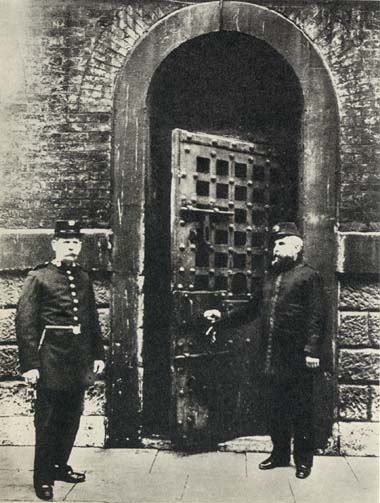
The book is another Victorian London historical fiction. We meet Margaret, the eldest, single sister in her family, as she starts her first day as a Lady Visitor to the infamous Millbank prison. Millbank is not a particularly nice place. At least by this stage, the worst prisoners in England were sent to another prison in London, but this was still not a nice place to end up at all.

Inside Millbank, Margaret meets a prisoner called Selina, who is a spiritualist. We all know how fascinated the Victorians were with the occult, spirits, magic and the like, so it isn't a surprise that Margaret is fascinated with Selina and her abilities, and ends up being drawn in deeper and deeper.

Right, so, we can all guess by now that I am a skeptic. In my experience these kind of people prey on people desperate for a message from someone they throw tells and information into the medium's lap. HOWEVER, the disclaimer for this book is that I wanted it to be all true for the story. I  am never one to let facts get in the way of a good story. Unless you swear to me something is a scientific fact and it is blatantly wrong. That pisses me off. Otherwise, I'm all for a bit of fun.

And while I wouldn't describe this book as fun, and while I couldn't completely disengage my disbelief this book drew me along quicker than I would have thought. And talk about a twisty ending!! I was hanging around 3 stars until I started hitting the twists. I didn't like it as much as Tipping the Velvet. I thought it may have been her first book, but looks like it was the second. And then it struck me, that was the problem with this book. It had a lot of second album syndrome to it. It wasn't bad, just felt a bit rushed and not quite as thought through as that debut.

A short review I know, but still a fun and surprising Victorian, gothic read.


Wednesday, 16 April 2014

The Shadow of the Wind - #51

Image sourced from here
I've been in a little bit of a reading rut lately. I'm not sure why, I just haven't really had the energy. I feel rather sad that I fell into it while reading this particular book. Luckily, this book threw me a rope or some other sort of laboured metaphor and helped me out of it. But I think unfortunately my opinion of this book suffered for it.

Don't get me wrong, I enjoyed this book immensely. Dark, gothic, mystery with hints of sordid pasts tied to civil war, mixed in with books, libraries and bookstores. All with a pinch of Spanish passion and melodrama behind it all.

We meet Daniel at 10 years old living in Barcelona. His Mum is dead and it's just him and his Dad. His Dad owns a bookshop that they live above. One night, Daniel's Dad takes him to an amazing library/depository called the Cemetery of Forgotten Books. Daniel can choose one book to take with him, as long as he does everything he can to protect the book while it's in his possession. He chooses the book The Shadow of the Wind and this choice embarks Daniel on a lifetime of obsession and discovery about the author and the book.

What I found confusing, that may be too strong a word, disorientating about the book was I kept on reading the dates, but the book itself kept on convincing me we were in a story set about 100 years earlier. 1850 say, instead of 1950. This was probably the gothic aspect to the storytelling honestly. But I was always a little surprised when they mentioned telephones or cars again. This was particularly so when at some stage in the book we visit a convalescent home. I felt I was back in Bedlam during it's not so pleasant heyday, not 1950s Spain. However, the book did make me brush up on my Spanish modern history, trying to work out who was who and who hated who and what not.

It was a great read. I think I missed some things with the 3 weeks it took for me to get through the first third of the book (yes, I took longer to read it and probably didn't pay attention. It's been that kind of month), but once I hit that point, the book took on a momentum of it's own. And I had to wake up and pay attention as I would get left behind, and also because I wanted to be swept along with it. The last third of the book was just constantly punctuated with "Oh my god!" or sharp intakes of breaths. Just when I thought it couldn't top itself, it would surprise me again.

This rating is an honest "it's not you, it's me" one. Maybe one day I will pick it up again and give it all the time, love and attention it so greatly deserves. I will definitely check out it's sequels though.


Sunday, 23 March 2014

The Rook

This is an exceedingly clever book. In an nutshell, this book is like Neil Gaiman and Jasper Fforde had a beautiful, beautiful Aussie love child.

Daniel O'Malley is a Canberran author. I somehow, and am still not sure how, managed to score a copy off his Mum (who I actually don't know). But now that disclosure is out of the way, in case I wasn't clear before, this is an absolutely fantastic book.

The Rook is an urban fantasy set in London. We start the book meeting Myfanwy (pronounced Miffany by the way, not Mif-fan-way) Thomas, the protagonist, in a park, in the rain, surrounded by a whole heap of dead guys, wearing gloves. Oh, and she can't remember who she is. In terms of beginnings, not a bad one. We go on to find that Myfanwy knew this was going to happen and has left new Myfanwy lots of info in the form of letters and folders to help her along, and make a choice about her new, inherited life.

This sounds like it could be a terrible way of disclosing information to the reader. But it's not. It's bloody well executed. We find out the lore and background to this urban fantasy and the characters as we need it, in an unjarring way. It bombards you with the info you need in an accessible and believable way. *THIS* is something incredibly hard to do, and honestly a lot of fantasy and sci fi fails at. The amount of times I have tuned out the 3 chapters of mind numbingly boring history of a world in fantasy or sci fi.

That's one element of the cleverness. Another is the world. It is well thought out, plausible, and just fun. I mean, supernatural powers, secret service, tied up in history. What's not to love? But on top of this, the world building is fantastic, and actually rather unique. And that is possibly the highest compliment that one could give an urban fantasy these days.

The most important for me, is this book is fricking hilarious. It is rare that a book in this genre is able to poke so much fun at itself, and everything around it. The humour is just leaking out of it. Whether it is his Australian command of a metaphor or a simile (there is a metaphor or a simile for everything if you try), or his poking fun of Americans (love you all, but some of his lines made me snort beverages out my nose) or any other nationality, or just sarcastic observations in general, the guy is funny.

And it all just made the book a pleasure to read. Action, intrigue and funny. This is my point about the Neil Gaiman and Jasper Fforde Aussie love child. He takes the elements that I love of both authors; world building, story, action, intrigue, and wit. And puts an Aussie spin on it that you would only notice if you are paying attention.

So I know I may be a bit behind the times, but read the book. I applaud and take my hat off to him. I know he is writing a sequel at the moment, and I hope it lives up to the first book. I'll just be watching jealously in the meantime as you all read this one for the first time.


Wednesday, 5 March 2014

The Name of the Rose - #50

Image sourced from here
What complete and utter self-indulgent wankery.

That is my opinion in one sentence. Feel free to stop reading now, as that is pretty much the long and the short of it. Eco seems so desperate to prove to everyone how incredibly clever he is, even though he is a leading academic in his field of semiotics as far as I can tell. So with this incredible insecurity shining through, he takes a wonderful premise for a story, but is incapable of keeping his hand off it for two pages at a time, so we get 500pp of "look at me! look at me!!!!".

I am really, REALLY annoyed. I saved this book for close to the end of my Around the World trip, as it was supposed to be wonderful. I kept reading even though I didn't enjoy it at all, as people were all "I didn't like it except for the end WHICH WAS AMAZING!" It's not. I promise it is not at all. I picked who the mastermind was 100 pages from the end as I was so bored and skipping half the pages of blatant symbolism that us-normal-peons-are-too-stupid-to-understand-but-look-how-wonderfully-smart-Eco-is, and thought I would have some fun picking the most preposterous person. Hmmmm.

Also, if you can't speak Latin, you're kinda stuffed. Because even though the book is translated from Italian to English, they decided not to translate the Latin. Because everyone speaks Latin these days. Uh huh. I thought this would be okay. I thought it would be fun and I might learn something, so I translated the first couple of phrases on post it notes, in case I needed to translate a couple of things later. This got old after about 30 pages. Especially as the monks talk more, as apparently, half their speech has to be in Latin. I know they did speak Latin, but translate it in a translation ffs. As you keep reading you can't help feeling that everyone knows more than you. Later we throw German into the mix too, because, you know, we can.

This would be a forgivable, although annoying, problem except intersperse the Latin with:

  • Complicated, unnecessary most of the time, obscure Catholic politics of the 12th, 13th and 14th Centuries. Long, long, long sections that discuss which weird cults (which are only cults when people declare them cults, and that can change Pope to Pope) hate who and did what; 
  • Weird Catholic/medieval symbolism of Bible stories (thank god I've read that cover to cover a few times) and then odd, mutated, mythological creatures on steroids that are described in EXCRUCIATING detail and never mentioned again;
  • Constant ranting about how women are disgusting, evil, not good for anything, and we can't work out why God created them. I get that was normal Catholic dogma in the 14th Century. However, we are talking about how if a woman is attractive and you notice her and are attracted to her, she is obviously a witch as why would you look at her otherwise and it's all her pact with the Devil. It was all too close to my own experiences and the teaching I was subjected to within the church around 2000. That just makes me feel ill, that in 6-7 centuries, in some groups/sections of Christianity, that hadn't changed that much; and
  • Ridiculously long and complicated (half in Latin) philosophical debates about life, the universe, everything, logic and rhetoric. When they started debating the philosophical merits of unicorns (which they believe existed) for several pages, there were audible screams.
I can't for the life of me work out why 38% of ratings are 5 stars. And another 36% are 4 stars. The only possible explanation I can come up with is that reading this book lures you into a form of Stockholm Syndrome. Or it's the psychological phenomena they have observed, that occurs when you do something for tenuous reasons and little reward, you convince yourself you liked it, enjoyed it and chose to do it, so your brain can cope with why you did it in the first place. Eg. you eat a bug for a monetary reward. But after you do, you only get given 20 cents as your reward. There is a disconnect between the reward and your action, it's not equal compensation. You then convince yourself so strongly that you did it because you wanted to, not because of the money. It stops a psychological meltdown. It seems like a plausible explanation for this book's ratings.

I just felt the entire time Eco was having a pissing competition with someone, and I didn't know who. Other academics? Look how good I am, I can write academic papers and best selling novels? Or just the world? All I know is that I got dragged into one insecure man's willy jostling and I feel incredibly deceived and a little dirty about the whole thing.


Monday, 24 February 2014

The Hunger Games

Image sourced from here
I'm not sure about reviewing this book. I mean, why bother really when all that could be said, has been said. To the point of nauseum. But I guess it is worth jotting my few thoughts down.

I have managed to avoid The Hunger Games hype. I only found out about the books a few weeks before the movie came out. With Harry Potter and Twilight it was impossible to ignore. But while just as popular in many ways, it was possible for me to read this book knowing only really three things about it:

1. The main character was a girl with a ridiculous name.
2. There are boys and girls sent ever year to an arena style set up to fight to their deaths.
3. SPOILER The main character and SPOILER the boy has to survive as I saw them in trailers for the other movies

It was a good book. Fast paced. Believable dystopia. Competent female protagonist reasonably in charge of her emotions (well, until it turned into a YA romance).

And that is where it lost the plot. Figuratively but also a little literally. Now don't get me wrong, I do enjoy a love interest and you could understand it most of the time. But when you turn a pretty impressive, hunter, hard arse girl into a simpering girl in love (or "love") I get annoyed. Why do we still think that women (although granted some men too) turn into gushing, snuggling, "Schmoopy" calling, air kiss blowing imbeciles when love comes along? Or more accurately, encourage them to be like that. Hell I know enough of my friends who have done that themselves. Love does not mean you have to give up your sense of agency, people!

To be fair, this book wasn't that terrible about this, just the last couple of chapters. And then the last chapter was just harsh. So the last 3 chapters or so cost it a star. But otherwise, I can see why it's so popular.