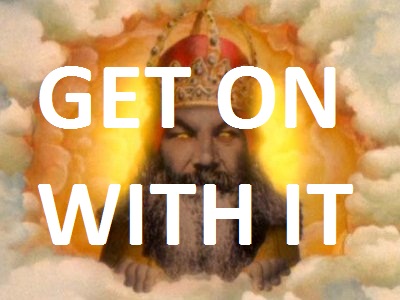
My Dad read a lot. But he read things you could learn stuff from (gardening, wildlife, natural history, woodworking, diy, history, military, politics, etc books) or biographies/autobiographies of sportsmen or military persons. So much so that when he passed away and my Mum came with us to his flat, she remarked that copy of The Bourne Identity was the first novel she had ever seen in his possession. And she had been married to the man for 15 years at one time.
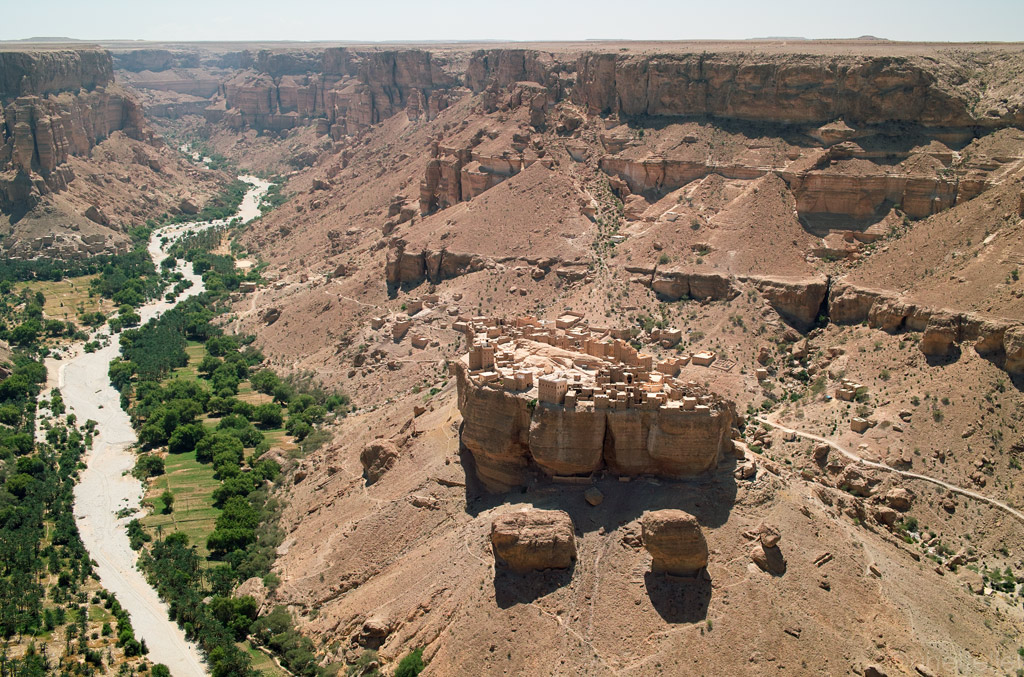
So that being said, the only novel my Dad ever recommended to me to read was this one. From what I can piece together, I think he had borrowed it from the library as he thought it actually was a book about fishing in the Yemen. It wasn't, and isn't, but Dad being Dad, seeing it was in his house for a month, he'd give it a go. And apparently he loved it.
I can honestly see why. It's the British kind of absurd he loved. It pays the crap out of those ridiculous people in London doing ridiculous things that his kind of Northerner doesn't get, and really, I only do as I live in the bureaucratic capital of another country. It's Yes Minister, but with fish and the Middle East. It is bloody funny.
It's a tongue in cheek look at the most boring man in British history who has been commissioned against his will through his civil service job to see if salmon fishing in the Yemen is possible. The book then follows him and his colleagues through the project and it's misadventures, and how it changes them.
It's also a rather insightful look into the political machine and British foreign policy regarding the Middle East in the 2000s. I'm glad Dad told me to read it actually. What I like about this book is very similar to what I loved about Dad honestly. Something so ridiculous and outrageous, in him the crazy Yorkshireman with the outrageous stories and the cheeky smile, but if you push further there was actually an incredibly nuanced understanding of foreign and military policy hiding within, both in the book and Dad. But Dad also had great information about growing tomatoes ;)
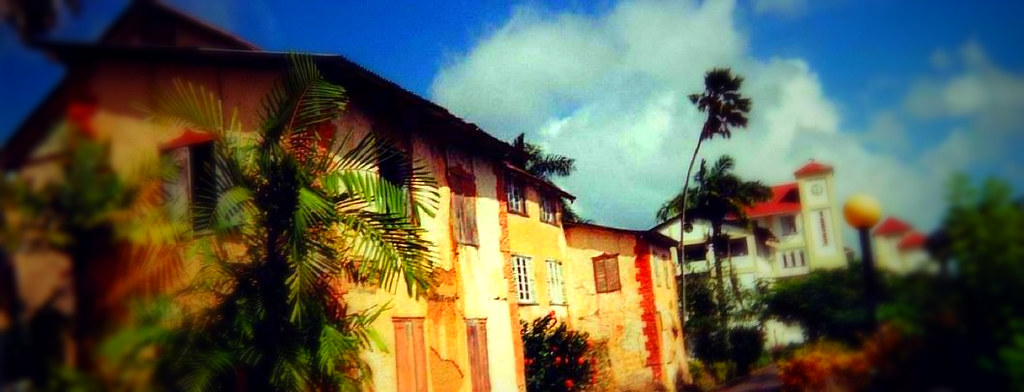
This is a novel of two parts. The first part is set in modern day, looking at the lives of Sabine and George as 70-something expats living in Trinidad. They have been there since Trinidad achieved it's independence and there is lots of discussion regarding what is still wrong with the country 50 years on. But more importantly, there is a lot going on with George and Sabine. And you're not sure what is happening, or what the history is. It slowly is revealed as the part, and the book goes on however.
The second part of the book is set 50 years earlier. It tells the story of George and Sabine coming to Trinidad as newly weds from London. The story is told from Sabine's perspective mainly, so you find out what it is like as a woman particularly on the island, where work wasn't an option as it would be for a man. But from Sabine, we get a look at the independence movement and the political atmosphere on the island from the observations in the street and the domestic house workers.
If I'm honest, the story was okay. I didn't like Sabine, so that made it hard. But the themes explored in the story, race, class, expat workers, political independence and agency was all well handled. I learnt a lot about Trinidad and it's history. I had a demonstration from my Trinidadian friend what steupsing was, which is important.
But the saviour was the writing, which was beautiful, descriptive and immersive. The descriptions of the island and the environment were invocative. I felt like I was on the island, looking at the flowers or iguanas, and feeling the heat. It lost the Prize-Formerly-known-as-Orange to The Lacuna, which I also enjoyed a lot more, but I can see why it was a contender.
I've been putting off this book for a while. Jasper Fforde and I have a turbulent relationship. The Eyre Affair is one of my favourite books ever. The next two I enjoyed, I love his writing style and his layers upon layers of literary jokes, but they slid down the meh slope for me. Then, as I owned them all by now, I got to Something Rotten and the love affair was back on. Restarted the series and we were back to meh. But a friend told me he loved the 7th book like the 1st, so I made myself pick this one up.
For this book, we are back in Bookworld. The thought that goes into Bookworld is always impressive, and this book came with a map! Love maps in my books! We are cruising around with written Thursday and soon discover that real Thursday has gone AWOL. Written Thursday sets about finding her, particularly as there is a civil war looming between Racy Novel and Women's Lit, that real Thursday is holding peace talks for.
Bookworld is so much more layered for me now, as my own reading has gotten more layered. I get more jokes and allusions. I wonder if I would enjoy the earlier books more now with this knowledge. And so many puns! Amusing, and sometimes incredibly clever. I can't believe all of it comes out of one man's mind.
But with all this added in, did I love it? Nope, but I enjoyed it. I am back on the side of reality in expectations for the next one, and hopes it surprisingly blows my socks off.
If you want to learn about royal history across Europe, over hundreds of years, this book and it's predecessor Sex with Kings, are the books for you.
I really enjoy this author. She has a way of taking history and making it fun. A lot of that is through her writing and prose, it's accessible and doesn't feel like you are reading a history book. She also has a way of writing about the subjects which make them feel more like characters in fiction than real people. I guess you can say that in some ways, royals are.
This book takes us through the halls of palaces in Germany, England, Russia, France, Spain and Italy looking at the women who were the most powerful women in their lands. And the things they got up to either in secret or with everyone's knowledge. She handles her subjects with grace and dignity, and without judgement.
Until.
Until we hit Diana. Then you can feel the judgement and almost scorn seeping out of the pages. Which was so so disappointing when the rest of the book was handled very differently. It left an icky taste in my mouth, wishing that I had stopped reading that chapter earlier. So I recommend that you all read the book, but stop that chapter earlier.
Well. That's done. I've been meaning to read Wuthering Heights for years. It's a "Classic" (so along with that goes all the cultural references I have never really got). The Brontes are hailed in some circles as better than Austen. It's the most romantic story ever written.
Let me address those assertions. Bullshit.
Wuthering Heights is a book about the most stubborn, sullen, sulky, self-centred, selfish (I've unintentionally gone to alliteration and I have now run out of s words), prideful, petulant, bad tempered, greedy, hypocritical individuals I have ever had the displeasure of reading all shoved into one book.
I'm at a loss of why the book has been taught in high schools around the world for years. The story isn't particularly interesting or complex. The writing and language is easy to read and understand, which possibly makes it a more accessible option. Some people may have problems with the dialect parts, but to me that was just a Yorkshire accent. I actually stopped reading it as although I could understand it, it did take a bit of brain power to switch in and out of it and most of what Joseph said was rubbish anyway. Is it taught with the lesson "all these characters are who you should not grow up into"? Because that would make sense, a warning not to be like them.
This is a book of abuse. Really, that's what it comes down to. Severe manipulation of people, with liberal sprinklings of physical, emotional, psychological, and no doubt in my mind in the background, sexual abuse. Now I am far from being a prude or easily offended. I have read many a book that deal with these issues and themes. But in most other books there is a story that turns those situations into plot devices. Wuthering Heights doesn't have this. It is a chronicle of how people wish to control and/or destroy other people, mainly for the sake of it. It left me feeling a bit off in places.
And for the romance. There was hardly anything. There was fighting, sulking, screaming, name calling, shunning but not romance. I knew beforehand that Heathcliff and Cathy were supposed to love each other, but I would have found it hard to see if I didn't have that context. Life is too short to have a relationship like theirs, and it definitely is too short to read about it.
Positives? Well, as I said it was easy to read for a classic. That's good. I will now understand cultural references made about Wuthering Heights, so I can appear more intelligent in very certain conversations. And the moors. Can't go wrong with the moors. I can frolic over the moors myself and leave Cathy and Heathcliff behind.
You know when you find a book with a really interesting premise. One that makes you think, if this works it could be great, but if not... Yeah... This book is the example of it not working.
This book is a family saga over roughly 100 years in Turkey. It follows the grandmother, through to the granddaughter, but looking at everyone in between and beyond. What it tries to do is to tell the story through the eyes of the houses. Which would be interesting, if it did it. Or was consistent. It was neither. It would be thrown in sometimes at the beginning of the chapter if it was remembered. Otherwise it carried on as an omnipotent narrator, but threw the building card in now and then. And then ignored it completely and discussed things there was no fricking way a building a couple of kilometres back could observe. It was haphazard, sloppy and badly executed.
Also, as I am pedant and such. There were 5 houses. Not seven. We went back to two.
Maybe, if the characters were interesting it would be forgivable that you forgot the premise you named your book after. Beauty Queens are not interesting to me though. Sorry. I maybe a failure to my gender, but primping and preening to be beautiful is fucking boring and a waste of my time in real life, let alone reading it for a while. Even if it is one small part of the story, boring, snoring, doring...
Also, maybe I had a really sheltered childhood. I mean, I had brothers, and boys on the street I played with every day, but we never had the need to show each other our bits every five seconds. I am sure we did and went, well that's odd, and moved on. What is with the overt sexualisation of children in every second book I read? I understand that teenagehood is a western construct. I understand there is a thin line between kids and adults in many cultures. I understand that a lot of kids in many cultures around the world live in the same room as their parents sex life.
But what is the need for any book not written in a western or Anglo background for sexualising children in the first few pages? Is it to shock me into another culture? Coz cheers, got that, not completely fucking stupid. Is it something I was incredibly sheltered from? Was everyone else as children humping anything that walked along? If so, I stand corrected. Or was she trying to make a point about a repressed sexual society? I don't know, but it grated me (obviously) whatever she was planning. And this is not about the obvious child sexual abuse case. This annoyed me before that story, at least that was explainable and understandable.
As a family saga, it wasn't horrible. It interested me a little in what was going on, and the family at large. I assume it gave me some insight into Turkish society, or probably more accurately, a Turkish diaspora's or immigrant to another country's opinion of Turkey. Overall a big Meh from me. It wasn't terrible, but if it wasn't for the challenge I read it for, I wouldn't have finished it.
I don't really like horror books. I find them unrealistic, usually funny and not very scary. But what does scare me are believable dystopias. Ones I can see us hurtling or even just crawling towards. Political decisions leading us towards a dictatorship we don't recognise. Reliance on technology or medicine that leads to dependence and thus control. Censoring to the point of lack of free thought, or lack of an educated population to challenge authority. Completely and utterly ignoring the looming ecological disaster that is coming towards you from a stubborn state of denial. Each and everyone one of these statements could in someway be applied to Australia at this point in time, and it's terrifying to think what could just be around the corner from us. But I love reading them, because if you don't think about what could be coming, how do you possibly avoid it? (Besides building a bunker in your backyard of course).
Oryx and Crake is one of these kind of books. It's completely perturbing as you can see it all happening. Everything is rather plausible. Of course as with most scifi, there are a few scientific jumps, but not to the realms of unlikely. And most terrifyingly, even if you sit and think on it for hours and hours, you're not quite sure how to, of if we could, stop it.
This was a very welcome surprise. I have had mixed experiences with Margaret Atwood. I enjoyed The Handmaid's Tale for the same reasons as this book. Lexx has read it too, and wasn't as taken with it as me. I do wonder whether there is something particularly chilling about that book that you can only fully get as a woman. The lurking misogyny lingering at the fringes (and in the spotlight more often than we'd like) of our culture. All it needs is a catalyst... I have also read The Blind Assassin, which I did not enjoy much at all and honestly wish I could get the time back I spent reading that novel.
As you will have guessed though, this book fell squarely on the good side of Atwood's books. I did feel though that there was an awful lot of backstory while I was reading it. I wasn't sure how much of Jimmy's childhood was really relevant, or was it just Atwood trying to build up a society. At the end of the book I definitely felt more of it was relevant than I had thought while reading the first three quarters of the book. Not meaning to spoil at all, just saying, if you are struggling with this too, stick with it.
The book is a pretty substantial rollercoaster through the emotions. Anger, disgust, sympathy, empathy, outrage, heartbreak. What it isn't, is a hardcore scifi, and that's what I love. I am more about the sociological, psychological scifis. That gets me going. However, if you are all about the SCIENCE! in your science fiction and want to move into the softer elements of scifi, this isn't a bad option as there is a heap of biology and logic discussions to "ease" you in. And terrify you.
This is an exceedingly clever book. In an nutshell, this book is like Neil Gaiman and Jasper Fforde had a beautiful, beautiful Aussie love child.
Daniel O'Malley is a Canberran author. I somehow, and am still not sure how, managed to score a copy off his Mum (who I actually don't know). But now that disclosure is out of the way, in case I wasn't clear before, this is an absolutely fantastic book.
The Rook is an urban fantasy set in London. We start the book meeting Myfanwy (pronounced Miffany by the way, not Mif-fan-way) Thomas, the protagonist, in a park, in the rain, surrounded by a whole heap of dead guys, wearing gloves. Oh, and she can't remember who she is. In terms of beginnings, not a bad one. We go on to find that Myfanwy knew this was going to happen and has left new Myfanwy lots of info in the form of letters and folders to help her along, and make a choice about her new, inherited life.
This sounds like it could be a terrible way of disclosing information to the reader. But it's not. It's bloody well executed. We find out the lore and background to this urban fantasy and the characters as we need it, in an unjarring way. It bombards you with the info you need in an accessible and believable way. *THIS* is something incredibly hard to do, and honestly a lot of fantasy and sci fi fails at. The amount of times I have tuned out the 3 chapters of mind numbingly boring history of a world in fantasy or sci fi.
That's one element of the cleverness. Another is the world. It is well thought out, plausible, and just fun. I mean, supernatural powers, secret service, tied up in history. What's not to love? But on top of this, the world building is fantastic, and actually rather unique. And that is possibly the highest compliment that one could give an urban fantasy these days.
The most important for me, is this book is fricking hilarious. It is rare that a book in this genre is able to poke so much fun at itself, and everything around it. The humour is just leaking out of it. Whether it is his Australian command of a metaphor or a simile (there is a metaphor or a simile for everything if you try), or his poking fun of Americans (love you all, but some of his lines made me snort beverages out my nose) or any other nationality, or just sarcastic observations in general, the guy is funny.
And it all just made the book a pleasure to read. Action, intrigue and funny. This is my point about the Neil Gaiman and Jasper Fforde Aussie love child. He takes the elements that I love of both authors; world building, story, action, intrigue, and wit. And puts an Aussie spin on it that you would only notice if you are paying attention.
So I know I may be a bit behind the times, but read the book. I applaud and take my hat off to him. I know he is writing a sequel at the moment, and I hope it lives up to the first book. I'll just be watching jealously in the meantime as you all read this one for the first time.
This book kicked me. I was sitting there thinking about the human condition, and why we are such scared arseholes, and a baby chicken jumps up next to me, snuggles down and wraps her head around into my lap. Some times we aren't I guess. Some times chickens, who are a bit naive, love you to bits. So I think this book should be sold/lent/issued with a chicken. So you have something fluffy to love you while you read it.
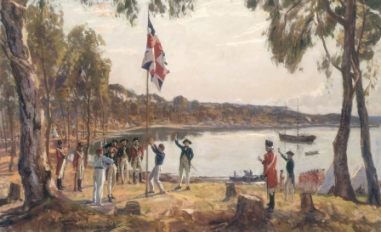
That being said, the book was great. It was a book that tells you the story of William Thornhill, who was born into extreme poverty in London. He turns to being a thief but is given a chance at life by being taken on as a waterman's (boatman's) apprentice on the Thames. He marries the girl he loves, and everything is going well. Until it is not. Like so many people in the 1800s. He is caught thieving again, sentenced to death but reprieved by being sent to the colony of New South Wales.
I feel like I have spoiled half the book for you. But THIS is where the book begins. This book tells the story of so many men and women that came out to Australia in the 1800s. They were shipped from the biggest city in the world to the most remote place on earth. And they survived, and prospered. As a great, great, great, great granddaughter of one of them, that's astounding, and I'm glad they did.
What is the thing that makes me emotional though, is not that part. It's what white Australians did to survive. That's the thing that kicks me in the guts. That's the thing, as an Australian that I know is creeping up on me from every crevice of this book. I understand. I understand the terror. The fear of the unknown. The fear for your family. But it does not excuse at all the horror we unleashed again, and again, and again, and still again even now.
There is still a division in our country. We should be better. We are slightly, but not at all enough. The right calls this a guilt agenda. I do not feel guilty for what my convict ancestor did or didn't do in 1820 or so as he didn't know better. I feel guilty as educated people in 201...4 we are doing terrible things still.
This book was brilliant and humbling. And if you don't know much about the very first settlers to Australia from Britain, it's not a bad way to learn.
While on this little urban fantasy interlude, I decided to pick up Grave Dance, the second of the Alex Craft novels I enjoyed in February The covers don't get better just by the by. We pick up with Alex a month after the last book finished. Death is handing around in his deathy kinda way, but faery boy has gone missing. And Alex is trying to deal with some of the repercussions and revelations that obligatorily occurred during the last books climax. However, the police ask her to come investigate some chopped off feet, and all of a sudden people start sending magical constructs to try and kill her.
This was a weaker book than the first one, definitely. It was still fun, but I got bored a few times with it. It also got a lot more convoluted. And I don't know how much of that story I needed in this book. Honestly it felt like a lot of it was just set up for the next book. And I hate that when people do that. Tell me that next book if it's important. Or leave it out.
But this all being said it's still, like I said before, fun. we have surly, sarcastic Alex, hot Death, hot faery boy (he shows back up), cool witchy or faery housemates/friends, gargoyles, ghosts, hairless dogs, etc. We learn a lot more about Faery which is definitely interesting. The world building is still great. We just needed an edit I think.
While I was overseas, I finally bit the bullet and started a Wodehouse. This is an important time in every girl's life, and I am very happen that it occurred while I was actually in Wodehouse country. I am really quite serious about that last part. I cannot imagine a better intro to Wodehouse than I have had.
I picked up Something Fresh, the first in the Blandings Castle series, in a bookshop in Oxford. I had luckily discovered that morning, that I had brought the wrong book overseas with me for the September Challenge I was running. So I just had to buy another book. Life is so incredibly hard sometimes.
The book starts in the West End of London, which we had just been spending the last week wandering around exploring. I could imagine perfectly the streets or buildings, if I didn't know the exact area it was describing. When we weren't in London, we were up in Oxfordshire visiting my brother who was in an old family manor/stately home which had been converted to a hospice. But it was very similar to what I imagine Blandings would have been like. Just a bit smaller.
The book itself was fun. A little old fashioned, but no more than other writers of that era are now. But I can see why he is such an acclaimed writer. The book introduces us to the Threepwood family, their staff and friends. This time we meet them when it looks like Freddie, the youngest and particularly useless Threepwood, has just gotten engaged.
The story honestly is a little thin, but that's not why you read Wodehouse. You read him for his interactions between people and his observations of just about everything around them. And when he is does this and pointing out the slight absurdity of it all, he is brilliant. I am not a huge fan of slapstick either, but when it is written in such a dry, sarcastic... British, way. Oh I was nearly crying with laughter on the train. I highly recommend picking it up for a light, fluffy read.
I have issues. I really do. It's a known thing, and when Lexx recommends books to me, one such caveat that is usually given is "there's a long description of lore/politics/history/science in the middle of the book". Now usually, those are things I get off on. As if I need to tell you guys. Mythology is my not so secret weakness. I love understanding the history of a place/event/person. Politics helps everything make sense. And science is fundamental to understanding anything. Including the three subjects above.
But what I don't like is the author taking me on 50 or 100 pages of this at once. Interweave bits and pieces in to the story, and I am yours. But I realised this style was not my thing in 1984. At least I loved the book though, so I paid attention for 80% of it. Then Lexx made me read one of his all time favourites, Magician, with a good warning that if I wasn't that into that part of 1984 (I had warned him when I passed the book over) I may encounter again. I did. I was bored.
So, when I was reading Solaris, and then I hit page after page after page of "science" of the planet and the scientific social history of the scientists, I was ready to scratch my eyes out. Which was disappointing. Because the other half (yes, HALF) of the book, which was the actual story, was fascinating. I wanted to know more about the stationed scientists, Kris, Snow and Sartorius - who I still know almost nothing about and just had to google him to find out his name.
I want to know more about the appearance of the visitors, I want to know who or what Snow's and Sartorius' visitors were, I want to know what happened after with the sea, I want to know more about Kris' and Rheya's relationship in the past.
Instead, I know more about a fictional planets formation of plasma waves that act like a geological formations than I ever, ever need to. I know the differences of some made up, dead scientist's theory against another made up, dead scientist's theory. In fact, I know the differences between many of these, both theories and people.
You know why I think it annoys me? Because I will never be able to remember all the information I will learn about this world. Trying to remember all the fascinating bits of science about the real world is hard. Remembering all the relevant bits of history to understand our world is pretty impossible. I can hardly speak one language, let alone any others. I can't remember all the facts of the wonderful and beautiful stories I have already read.
And then to spend a novel filling my head with pages and pages of "science" that was drier than my Advanced Issues of Cognitive Neurobiology textbook I have somewhere (complete snoozefest), I feel cheated!! I could use that space in my brain better. You could use that space in your novel better!!!
I gave the book 2.5 stars. Mainly as the half of the book I enjoyed, I really enjoyed. It was just let down by the other half.
I got given Jane Eyre many years ago. Much to my mother’s distaste. In fact I mentioned to her the other day I was reading it and she groaned. And flopped over. And continued groaning and stooping lower and lower until her arms were dragging on the floor while she trudged around the kitchen at an incredibly slow and thumping rate.
If you think I’m prone to overreaction and drama, you should meet my Mum.
It then emerged that she couldn’t quite remember reading it as she ran around the house warbling “Cathy!!!” and I pointed out that was the wrong sister and book, not that I have read Wuthering Heights either. She did finally remember reading it when I was speculating on the end, and she got an evil grin on her face, opened her mouth, clamped both hands over it quickly, and ran away.
See my previous comment. Throw in my Dad’s Yorkshire tendencies to tell long, rambley stories over a pint or 7, and I didn’t stand a chance.
So on my second attempt to read it, I finished. I had to read it. We share a name. In fact when I came across the quote, which I actually really like;
“Do you think, because I am poor, obscure, plain, and little, I am soulless and heartless? You think wrong!” –p282
I am wondering if my good friend in high school calling me (and writing all over my stuff) “Jane, plain and small” was actually her being literary. Strong possibility.
So what did I actually think? I loved the first half of the book. Besides the love of semi-colons (says the girl with the love of commas and parentheses), I really enjoyed the writing. And she at least knew how to use those semi-colons. I loved the feeling of being back in Yorkshire. I loved the moors. I liked Jane. I even liked Mr Rochester. As I said to Mum, “He’s actually quite funny and intelligent. Until he doesn’t stop talking. He just goes on and on and becomes ridiculous, and you just wish you could shake him and say ‘Oh just stop talking!! I liked you so much better when you weren’t talking!!’”. She pointed out in mirth that may be the pot calling the kettle black. Bah.
But then it goes a bit pear-shaped. The big twist in events happens. She meets St John Rivers, who needs to get the .. hell... over himself frankly. The book gets ridiculously preachy. I got stuck in sermons that I didn’t realise I being lead into, and that made me grumpy at the characters for breaching my trust. Oh and then the end! Dear god!
So I’m glad I read it. I liked the first 300pp or so. It was going to be a 4 starrer I thought. It would pull me out of this 3 star slump I’ve been in. But alas, it was not to be.
I try and make it a habit not to discuss overly discussed books. Although I don't think it would be fair of me to read this book without allowing myself the opportunity to respond to it.
I have heard about this book for years. It was one of the books I had to have read. It was one of the ones I *should* have read. I get so annoyed I had my 5 year hiatus of reading in my teenage years. I read one or two things, and read things for English at school. But after years of being ridiculed at primary school for reading and knowing things, I was determined not to in high school in order to fit in. It kind of worked. Until I read a book I loved and then devoured it with a rabid hunger that was screaming to be fed. I should have taken the hint I was a junky, but I was 14. I knew better.
The problem with this now, is that I am over 5 years behind on my reading (going on my stats from the last two years, averaging 20 books a year, that's 100 books I could have read). And when you are 5 years behind, there is a lot of reading you postpone again and again. Catcher was one of these.
I loved and hated Holden. There were things he said that I though were brilliant and I could not believe that a 17 year old could have said. There were moments where I wanted to slap him upside the face and give him a good shake. I thought long and hard since I finished it what 17 year old Rusalka would have though of him, and I don't think she would think much differently. She was a bit of a prude, although had a thing for the bad boys. God knows really. But the fundamental frustration and intrigue I think would have been similar.
I loved the bit though where he is talking to at the moment unnamed source (spoilers!) about the concept where the name of novel came from. That was beautiful. That was the part 17 year old me would have fallen in love. That's the main part of the book that felt real. However the rest of the book I wanted to kill him. He was so frustrating. And I know 17 year old Rus would have felt the same. We, her and I, have always had a small amount of patience for boys with self important bullshit.
In the end I can see why this book was mind blowing when it was written. I can see why 13 year olds may flock to it. But in a present day world. I don't quiet get it. Maybe it is the late 20s me that doesn't get it too. But I feel that great books can speak to you no matter your age, even if you can see that you would have loved it more at XX age. I'm glad I read it, but a little overhyped. I'm expecting to be burnt at the stake so go for it ;)
I finished this book a week ago. I still don't know what I want to say about it. Now don't think that means I didn't like it. I did. It's just one of those books that seems like anything you say will not do it justice.
The book tells the stories of three men. One, our main narrator Turad, is a Bedouin from the desert who through many misfortunes has ended up working in many service roles in Riyadh and feels rather bitter about the whole thing. Fair enough. The second is his friend, Tawfiq, who has been brought as a slave to Saudi Arabia from Sudan as a child. The third, Nasir, is an orphan who has been brought up in orphanages and foster homes. Most of his story is imaginings of Turad but we find the three men's lives have intertwined enough to give us some facts about Nasir's life.
The stories aren't particularly nice. It's not an overly happy book. But the storytelling has a great quality to it. It's almost magical. Like you're being whisked around by a hot desert wind, flitting to story to story, whirling into one narrative to the next. The feeling of a little sense of achievement when you find the smallest hints of a tie in to a larger story.
The book is banned in Saudi Arabia, and I'm not overly surprised. While not very political, it does touch on sexual topics I would think are taboo in Saudi Arabia. Hell, most of them are taboo in our culture. It did make me wonder if the character telling the story, or the author himself had underlying issues. However, he moves on quickly and carries on. It's just worth flagging, and if anyone else has read it, if they felt the same?
It's a short review. But it's a short book. I feel like I cannot talk about it too much as I may give away the story. If anyone is looking for a book about Saudi Arabia though, or by a Saudi author though, I definitely recommend this one. Don't read, Girls of Riyadh whatever you do. Garbage.
I'm running a challenge again this month for our Goodreads group You'll Love This One. This will happen now and then this year, and will just mean my Around the World reading gets pushed aside sometimes during the year if they don't fit certain challenges or themes (there are a lot of them, and I should be able to fit in my AtW reading for most of them). I think I have learnt in 2012, that while it is great to have a plan and stick to it, it is just as important to be flexible and have fun with your reading as well. I went from one extreme to the other, and 2013 I hope will be a lovely happy medium.
So this month's challenge had me reading Hood as a retelling of a myth or legend. Which I really enjoyed as I'm a complete sucker for mythology of all shapes and sizes (Rusalkas anyone?). The problem with this book is that it got the 1950s TV show theme stuck in my head. Although, within one bar morphs into this:
Right, so got that out of the way (dum de dum dum dum).
This story of Robin Hood takes Robin out of Sherwood into Wales. And his name isn't Robin, it's Bran. Also, forget about the Crusades and Richard the Lionheart. It's set in the 11th Century when William the Conqueror was swanning about. So really, forget most of what you knew about Robin Hood for this book.
Young Bran is the Prince in his part of Wales. The Normans have taken England, and are looking towards Wales with a not very nice intent. Bran's Dad has decided he should go to London and swear his allegiance to the King, however he has come to this conclusion too late. On the road to London, quite close to home, he and all his men are slaughtered by Normans. Besides Bran, who missed the leaving time of the convoy, as he was in the next Welsh kingdom over trying to get into the Princess Mérian's bed and another things. Bran's mate, Iwan, the King's Champion also escapes to tell everyone what has happened (convenient plot device!) and that the King is dead and the Normans are coming to take over everything.
Other stuff happens, Bran runs off to London with Iwan and a monk to try and get his kingdom back. Along the way, they stay with another monk, an Englishman, who can't pronounce Iwan so he calls him "Little John" and Iwan can't pronounce his name either, so calls him "Friar Tuck". Things don't go so well in London, and they go home, things get very messy and Bran is believed to be killed. But he gets nursed back to health, convinced of his rightful path and starts getting to what we have all been waiting for. The Robbing and the Hooding.
My complaint with the book is there is an awful lot of back story. I mean a ton. I don't think we even see Robin Hooding until around chapter 30. And when you're reading a book about Robin Hood, that seems like an very long time to wait. I do realise the book is a part of a series. But the point of the first book in a series is to draw people in. Get them excited to read the second and third (or if you're Robert Jordan, the tenth, eleventh, twelfth, you get my point) books. This book got there at the end, but I'm grumpy I read two thirds of the book before I got to what I was waiting for.
Luckily the book was well written and easy to read. Which was a blessing when you wanted to get to the story you picked up the book for. Stephen Lawhead obviously did a lot of research about the time and the area as well, and that shines through the book. It is a good book, it is just worth the disclaimer that it may not launch right into what you think the book is about. But it's an enjoyable journey to get there. I may pick up the other two books in the series at some stage, seeing as it just started getting interesting, but we will have to see.
I’m so behind on my reviews! I decided not to review all my
overseas reading at once like I did in June, but this means I’m reading faster
than I am reviewing and not catching up! So I think I need to throw that idea
out the window.
So, Night Watch. This was going to be my Russian read. Then
I had the brilliant idea of reading Anna Karenina as my Russian read (which I
haven’t finished yet), and as Sergei Lukyanenko was born in a part of the USSR that is
now Kazakhstan, this became my Kazakhstani read instead. Brilliant playing of
the system, however confusing when all the stories are set in Moscow.
I say stories as the book is pretty much 3 stories of around
150pp each, featuring the same characters and building on the events of the
story before it. I loved it. It was a play on the supernatural domains that I
hadn’t read before, with a distinctly European twist. It had magic and wizards
and such, but without the kitchness that the fantasy genre tends to fall into.
The basic premise is that there is light and dark magic.
When one finds out they are a magic user, or Other, they have to make a choice
between whether they are light or dark. But there is more to it than it seems,
as a lot of the time it comes down to the circumstances that the person is in
the first time they enter the Twilight (the magical realm). Ie, you’re in a bad
mood, you may end up on the dark side because of that, not because you are inherently bad.
Light and Dark are in a permanent truce with each other. In
order to police this truce, we have the Night Watch of light magicians who
monitor the Dark, the Day Watch who are dark magicians who monitor the Light,
and the Inquisition who monitor and police them both. This book was stories
about, funnily enough, the Night Watch (the second in the series is conveniently
called the Day Watch and confusingly the third is called Twilight Watch so not
sure on that one).
I wanted to read this book badly after we had heard such
good things about it in Aus, and then they released the movie before any of us
had read the book. And the movie was shocking. Absolutely appalling. Which
meant even more that we had to read the book. There is no way this acclaimed
book could have been that bad.
It wasn’t, it was great. The movie it turns out is based
just on the first of the three stories. This meant that the characters where
pretty underdeveloped in the movie. Turns out, because you have another 350pp in
the book to get to know them. The strange reasoning in the movie gets explained
in the book. Another reason why some books are just better left as books.
The moral to this particular story is to pretend the movie
doesn’t exist. It’s how we get on with our lives. So pretend the movie never
happened and read the book. The book has a wonderful spin on light and dark, good and evil, highlighting the fact that they are sometimes blurred, incomprehensible
and indistinguishable, even to those inside the system. 4 stars.
Yes, I know that image is Japanese not Chinese. Not to mention god knows what or who is doing what to whom. But it sums up this book for me. Elephant-Swan. The thing was huge.
This was one of those highly acclaimed and raved about books I had been meaning to read for a very long time. I was given it by my housemate who bought it at a garage sale down the road for 50 cents. He was very pleased with himself how little it cost. While appreciating the present, it was one of those occasions where you kinda didn't want to know how little was spent on you, no matter the bargain It has sat on my shelf since then, trying to lure me to read it to see if it was worth 50 cents.
Was it? Yes. Was it insightful? Yes. Was it astonishing? Yes. Was it informative? Yes. Did it inform me how much of a bad person I have become? Oh hell yes.
I was amazed and horrified at the autocracies described in this book. By the Chinese landowners, by the Japanese and especially by the Communists. I had no idea about the Long March. I knew the phrase the Cultural Revolution, but actually had no idea what it meant. Chatting to my brother the other night highlighted how my education has lacked from doing no history in high school and very little in Uni. He knew all about this stuff from a subject he took in Yr 12. I, however, was completely in the dark.
Which lead me to an interesting discovery. I was listening to Jung talk about how she could not challenge Mao in her mind. How she was brainwashed into believing he was almost a god and infallible. And I thought, how stupid do you have to be? Well, not stupid as the consequence was torture and either death or complete destruction of your family and their futures. But how could you accept this and not challenge it at least internally.
And then I realised. Being a child of the 1980s I was always brought up to think that China was wrong. That they were bad and not good. They had human rights issues and freedom of speech problems and you don't want to end up like them. Oh and that Mao guy? Bit of a dick really. Not very nice. And I, until this book, had never known why besides one or two stories I had heard over the years. Except I accepted this premise. It was what we were taught. It's what was right.
While I am definitely on that side still after reading this book, my questioning of her brainwashing, lead me to discover the almost brainwashing of my own. My quick judgement of her made me realise that as a child especially, it is so easy to be talked around to other people's way of thinking. While I'm not saying we are comparable to Maoist China, I am saying that maybe we are throwing stones and not realising we are in a glass house.
But that's not why I am a bad person nor why this book is an elephant-swan. Why I am a bad person and this book to me is an elephant-swan is because my boss, who happens to be a Professor of Literature (you know, I mention this for the street cred haha), saw I was reading this book. While work is still insane, she was all "You have to go and read this book!! Now! Stop that work and read! I was all puffy-eyed for over a fortnight while reading that book. I couldn't stop crying!!".
I sort of looked at her, and replied, "Really? Until we got to the Cultural Revolution I was a bit bored. Hopefully things pick up a bit now".
There was a bit of a blank stare in return.
Really. I was bored. I was just thinking over and over again:
If it wasn't for the fact I had to read the book in September I may have, possibly, dumped it. Not sure, as the positives for reading it far out weighed the bogging down bits. But still. Bad person. I mean, seriously, who gets bored hearing about a families persecution and torture and harassment by a flawed but immensely powerful system?!? Not a good one.
But whether I am a good person or not, it's 3.5 elephant-swan stars. Recommend to everyone to read who has no idea about Chinese modern history, but be prepared you may be bogged down in the middle. Or I'm just horrid.